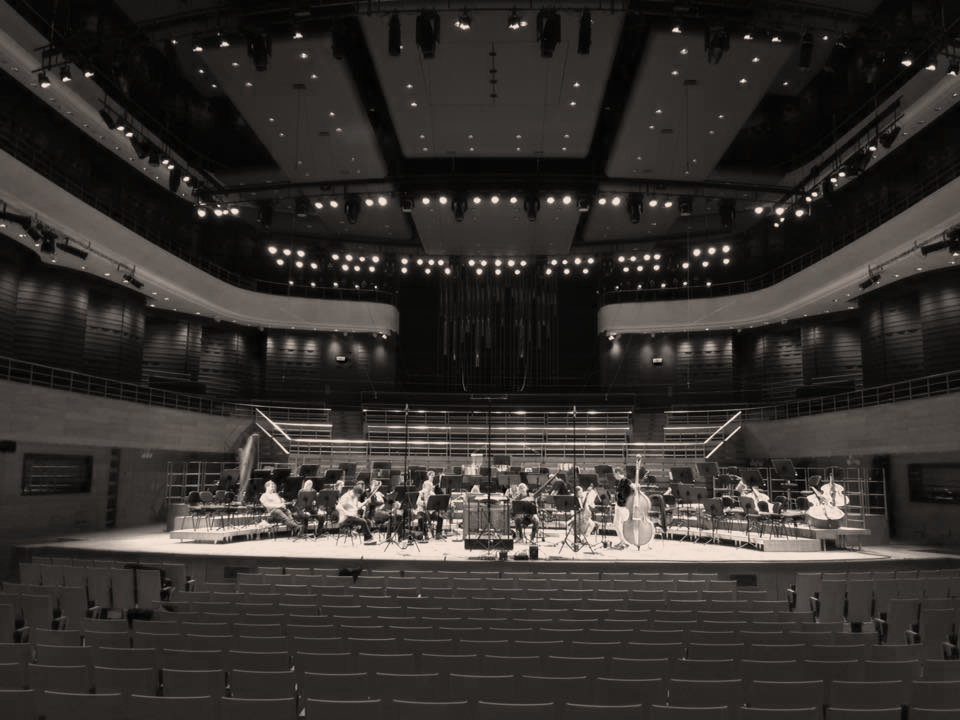
Three days of recording session with polish Baroque music in astonishing concert hall of National Forum of Music in Wrocław.

B.Pękiel – Missa Pulcherrima M.Mielczewski – Vesperae Dominicales
Wrocław Baroque Ensemble Andrzej Kosendiak – conductor Aldona Bartnik, Agnieszka Ryman – soprano Piotr Olech, Piotr Łykowski – countertenor Maciej Gocman, Karol Kozłowski – tenor Tomáš Král, Bogdan Makal– bass William Lyons – bassoon
” Bartłomiej Pękiel was the first Pole employed as master of the king’s music at the royal court in Wawel, Kraków. Before him, Italian composers held the post. Already his contemporaries knew they had to do with an outstanding personality: one of the artists, copying Pękiel’s Mass after Palestrina, added the word pulcherrima, i.e. the most beautiful, to the title. Pękiel’s mass is one of the fines examples of Polish Baroque a cappella polyphony. The fortunes of Marcin Mielczewski’s output illustrate the difficulties which researchers into early music have been facing. Today we know 120 titles by Mielczewski, of which one-fourth have not survived, and another one-fourth are known only in fragments. The 60 works whose complete scores we know today have not survived in original manuscripts, but in two printed editions and handwritten copies, with noted differences between print and handwriting. The Magnificat ending Vesperae Dominicales in the manuscript from Kromierzyż has an instrumental line-up different from the copy found in Gdańsk. Some of the scores were lost during World War II, and only old photos testify to their existence. What is certain is that Mielczewski’s music inspired composers of Orthodox Church music, and some of his works were adapted for Lutheran liturgy too. Perhaps Bach himself stumbled upon Mielczewski’s compositions in the Lüneberg school library he visited.
Pękiel and Mielczewski represented the times when Polish music was on the highest artistic level. Centuries later we discover anew the wealth of our native Baroque culture, and the consecutive editions of Wratislavia Cantans have played an important role in bringing it back to our attention. “
material from: http://www.nfm.wroclaw.pl/en/component/nfmcalendar/event/3206 review with photorelation of concert on web site http://vvena.pl/miasto-cudownej-muzyki/#prettyPhoto